
12 of 12 Top Hip Papers of 2025 | APTA Clinical Practice Guidelines for Ax & Mx of Hip Osteoarthritis: 2025 update
Here we are, on the final day of my 12 Hip Days of Christmas for 2025! I hope you enjoyed catching up on the 12 top hip papers of 2025 - papers that have contributed to our understanding of hip conditions and/or the assessment or management of hip pain or injury. If you haven't already, you can pick up the ebook for the 12 top hip papers of 2024 series. Keep an eye out in January for the ebook from the 2025 series. Our last paper for 2025 is the 2025 update of the APTA Clinical Practice Guidelines for Hip Osteoarthritis Assessment and Management. Find out what is supported as evidence based practice.
I hope you enjoy this last edition, and don't forget this in your last day to take advantage of my Christmas gift - a special discount on the Hip Academy joining fee - a community of hip lovers and hip learners, and the most comprehensive resource library for clinicians managing patients with hip, groin and buttock pain.
12 of 12 Top Hip Papers of 2025: APTA Clinical Practice Guidelines for Hip Osteoarthritis Assessment and Management1
Background:
This recent paper in the Journal of Orthopaedic and Sports Physical Therapy reports on the recommendations from the 2025 Updated APTA Clinical Practice Guidelines for hip osteoarthritis assessment and management.
Study Aims:
- To describe evidence-based physical therapy practice, including diagnosis, prognosis, intervention, and assessment of outcome, for musculoskeletal disorders (in this case, hip osteoarthritis) commonly managed by orthopedic and sports physical therapists;
- To create a reference publication for orthopedic physical therapy clinicians, academic instructors, clinical instructors, students, interns, residents, and fellows regarding the best current practice of orthopedic and sports physical therapy.
What was done:
An update of the 2017 APTA Clinical Guidelines for Hip Osteoarthritis assessment and management. The previous APTA Clinical Practice Guidelines for Hip Osteoarthritis were published in 2017. There has been quite a high volume of research published since that time, so it was time for an update. A systematic review of new literature was performed, the levels of evidence determined, and recommendations developed after feedback from experts and patients.
Methods:
- Systematic search for relevant literature: Jan 2016 - Aug 2025
- Authors determined:
- Level of evidence and quality of each article
- Strength of evidence was assessed and grades of recommendation determined
- Recommendations for clinicians treating patients with hip osteoarthritis were developed and refined after feedback from expert reviewers and public comment.
GRADES OF RECOMMENDATION
S Strong M Moderate W Weak C Conflicting T Theory O Opinion
Key Findings:
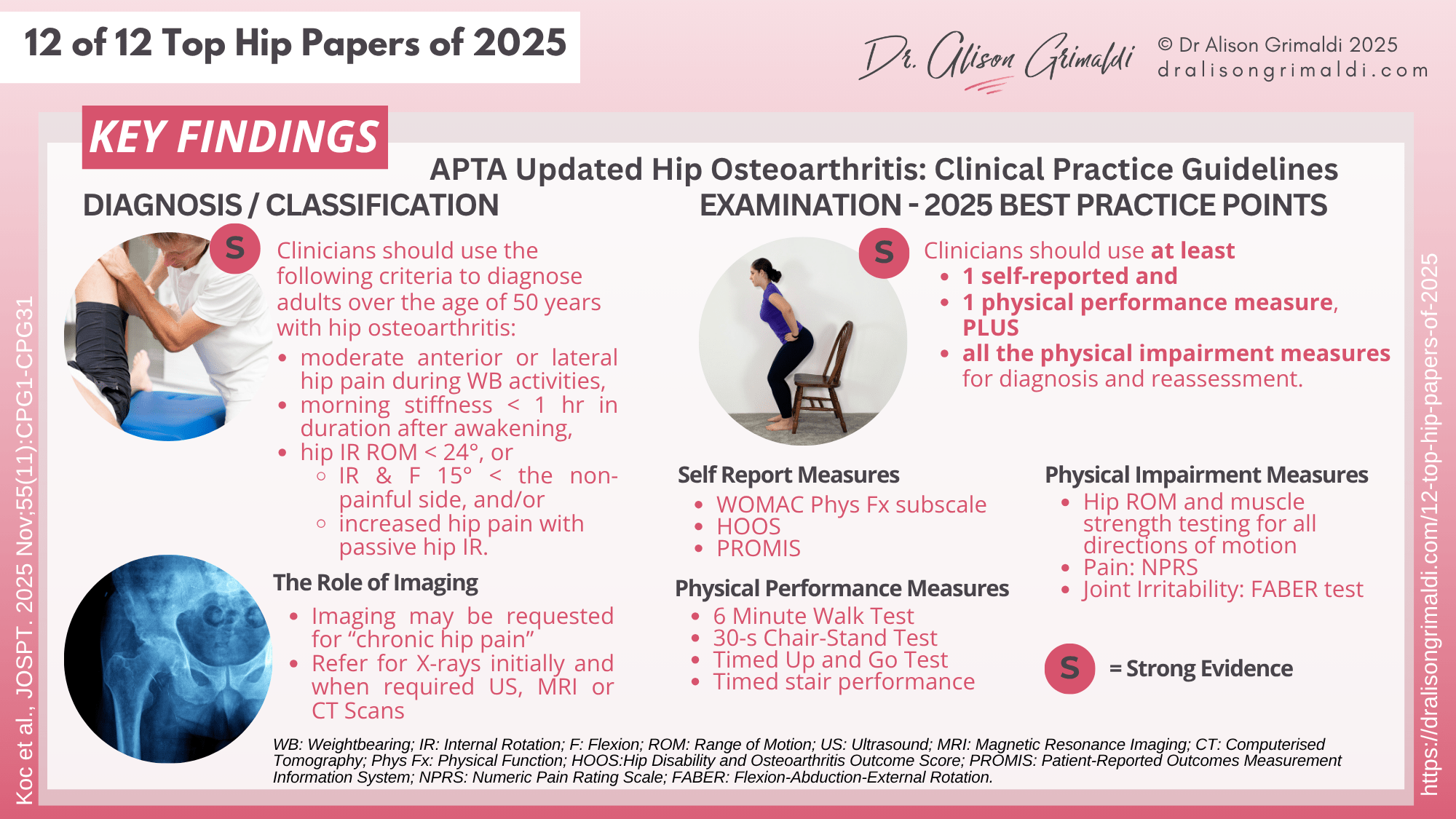
Clinical Practice Guidelines for Hip Osteoarthritis: Diagnosis/Classification/Examination
This updated clinical practice guideline for hip osteoarthritis recommended that clinicians should use at least 1 self-reported and 1 physical performance measure, plus all physical impairment measures for diagnosis and reassessment of hip osteoarthritis.
Recommended Self Reported Outcome Measures included:
- WOMAC Physical Function Subscale
- Hip disability and Osteoarthritis Outcome Score (HOOS)
- Patient-Reported Outcomes Measurement Information System (PROMIS)
Recommended Performance Measures included:
- 6 Minute Walk Test
- 30Second Chair Stand Test
- Timed Up and Go Test
- Timed Stair Performance
Recommended Physical Impairment Measures included:
- Hip range of motion for all directions
- Hip strength testing for all muscle groups
- Pain: Numeric Pain Rating Scale
- Joint Irritability: FABER Test
The guidelines recommend the FABER test for assessment of joint irritability. A lot of clinicians don’t use this test routinely, perhaps because it loads a lot of structures and requires a little more 'interpretation'. I have always liked FABER as a barometer for how 'grumpy' a hip joint is, so I agree that this is a useful indicator for hip joint irritability.
Clinical Practice Guidelines for Hip Osteoarthritis - Management
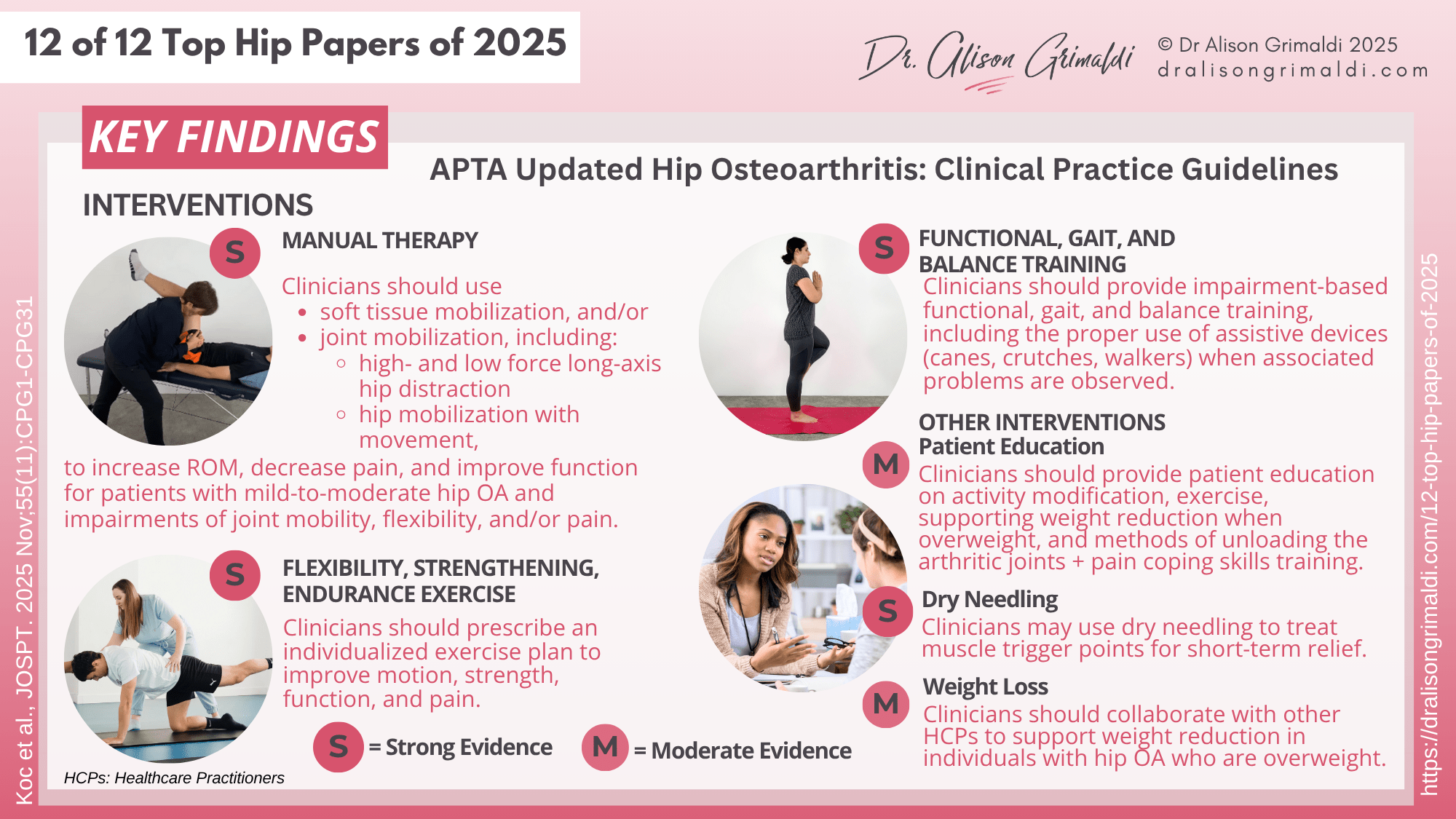
- There is strong evidence for the recommendation of exercise and manual therapy for the management of Hip OA.
- Functional, gait, and balance training is recommended when associated problems are observed.
It's great to see the strength of this evidence further supported by five meta-analyses, one systematic review, and eight randomised clinical trials (six Level I, two Level II) conducted since the 2017 Clinical Practice Guidelines. This is excellent evidence to share with referring medical practitioners and your community - exercise really helps hip osteoarthritis!
- Dry Needling is recommended in the guidelines for the management of hip osteoarthritis
There were no recommendations for Dry Needling in the 2017 Clinical Practice Guidelines, but recent research has contributed to a 'Strong Evidence' recommendation in the 2025 update. Dry needling is recommended for improving muscle extensibility, pain, range of motion, function, and muscle force production in the short term (3 weeks). There have been four high-quality randomised clinical trials and a secondary analysis that supported the use of Dry Needling to treat 'muscle trigger points' associated with hip OA (grade II or III). Dry Needling could be considered as one treatment method for providing some short term relief, together with an active exercise approach.
- Patient education and collaboration in weight loss efforts are also recommended.
- There is poor support for modalities and bracing in early intervention.
Clinical Implications:
This updated clinical practice guideline for hip osteoarthritis provides a useful update for clinicians regarding the state of the evidence in the assessment and management of hip osteoarthritis, and guides clinicians in evidence-based practice. There is often some delay in gaining research evidence for things that we find useful in clinical practice, but over the last 10-15 years the evidence base has certainly developed to a point where big ticket items for hip osteoarthritis such as exercise, and useful adjunct treatments such as manual therapy now have strong support. There is also strong evidence for use of functional, gait and balance training where individuals display impairments. These are the most powerful tools we have in our non-surgical toolbox.
It's nice to see though that there is now also some moderate level evidence for physiotherapist-led 'coaching' - education, advice, supporting weight reduction and teaching coping skills. These additional skills are important for physiotherapists to develop in order to provide a well rounded evidence-based intervention for hip osteoarthritis.

SPECIAL HOLIDAY OFFER!
$100 OFF
your Hip Academy joining fee
Offer Only Available During the 12 Hip Days of Christmas (13th-24th December). Do not miss this exclusive offer!
Now only AUD $345 (usually $445) to join to receive immediate access to over $4,800 worth of content!!
(AUD$345 equates to approximately 181 GBP and 230 USD)
USE COUPON CODE: xmas25hip
Like to learn more?
In this course, you can find detailed information on pathoaetiology, assessment and management of hip joint related pain (including labral tears and FAIS), and many other conditions. To learn more, take the online course, or join me in an online or face-to-face workshop.
A huge thank you to all the researchers whose work was highlighted in this year’s Top 12 Hip Papers of 2025. Your efforts continue to expand our understanding of hip conditions and help clinicians refine their assessment and treatment strategies to achieve better outcomes for those in pain.
I hope you’ve enjoyed following along with the 12 Hip Days of Christmas, exploring the key takeaways and visuals from each study. I appreciate you joining me throughout this series, and stay tuned for the upcoming ebook release in January!
Wishing you a joyful and restful festive season. I’m looking forward to connecting with many of you through Hip Academy and future online or in-person workshops in 2026.
Warm regards,
Alison

Missed paper 11? Click above to read it!
Sign up to my mailing list for updates and my WEEKLY HIP FACT FILES - with clinically relevant facts, stats, and featured papers.
