
10 of 12 Top Hip Papers of 2025 | The Broken Wing Sign: A Clinical Test for Gluteus Medius Tendon Pathology
It's day 10 of my 12 Top Hip Papers series of miniblogs for 2025! If you missed Day 9, you'll find a link at the bottom of this page to take you back. For day 10, we'll be looking at a new clinical test for detecting gluteus medius tendon tears, which can be helpful for the purposes of treatment planning and prognosis generation. Find more info down the page.
10 of 12 Top Hip Papers of 2025: The Broken Wing Sign: A New Clinical Test to Detect Gluteus Medius Tendon Pathology1
Background:
Awareness, particularly of massive tears of the gluteus medius tendon, can be helpful for the purposes of treatment planning and guiding expectations - clinician and patient. There has been recent interest in this topic, with the new Hip Drop Test also published earlier this year.
This prospective study describes the new Broken Wing Sign for detecting gluteus medius tendon tears and reports its diagnostic utility.
Study Aim:
- To introduce the “broken wing sign,” a novel physical examination test designed to detect gluteus medius tendon tears and associated muscle atrophy, and
- To evaluate its diagnostic accuracy and clinical utility.
What was done:
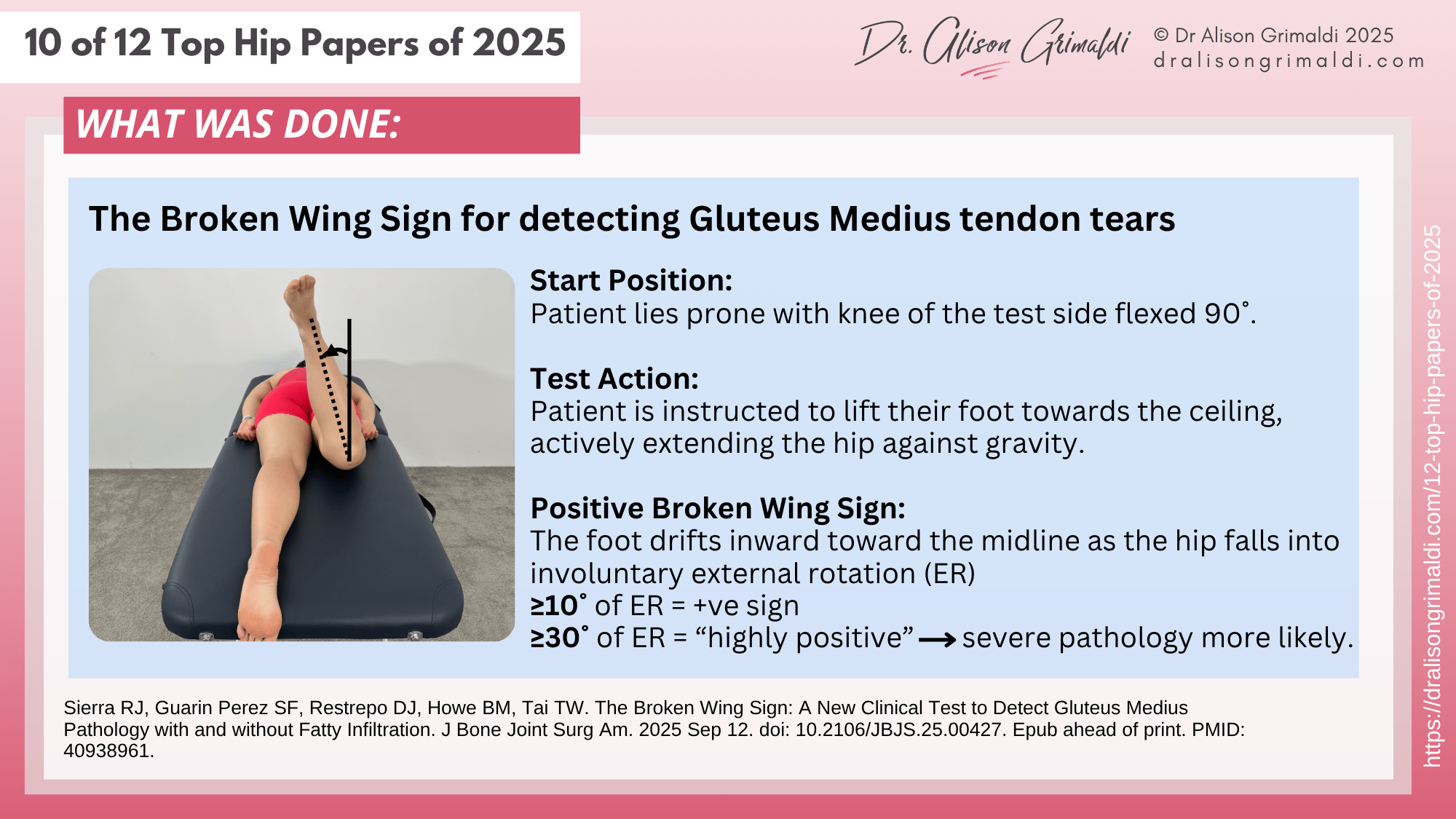
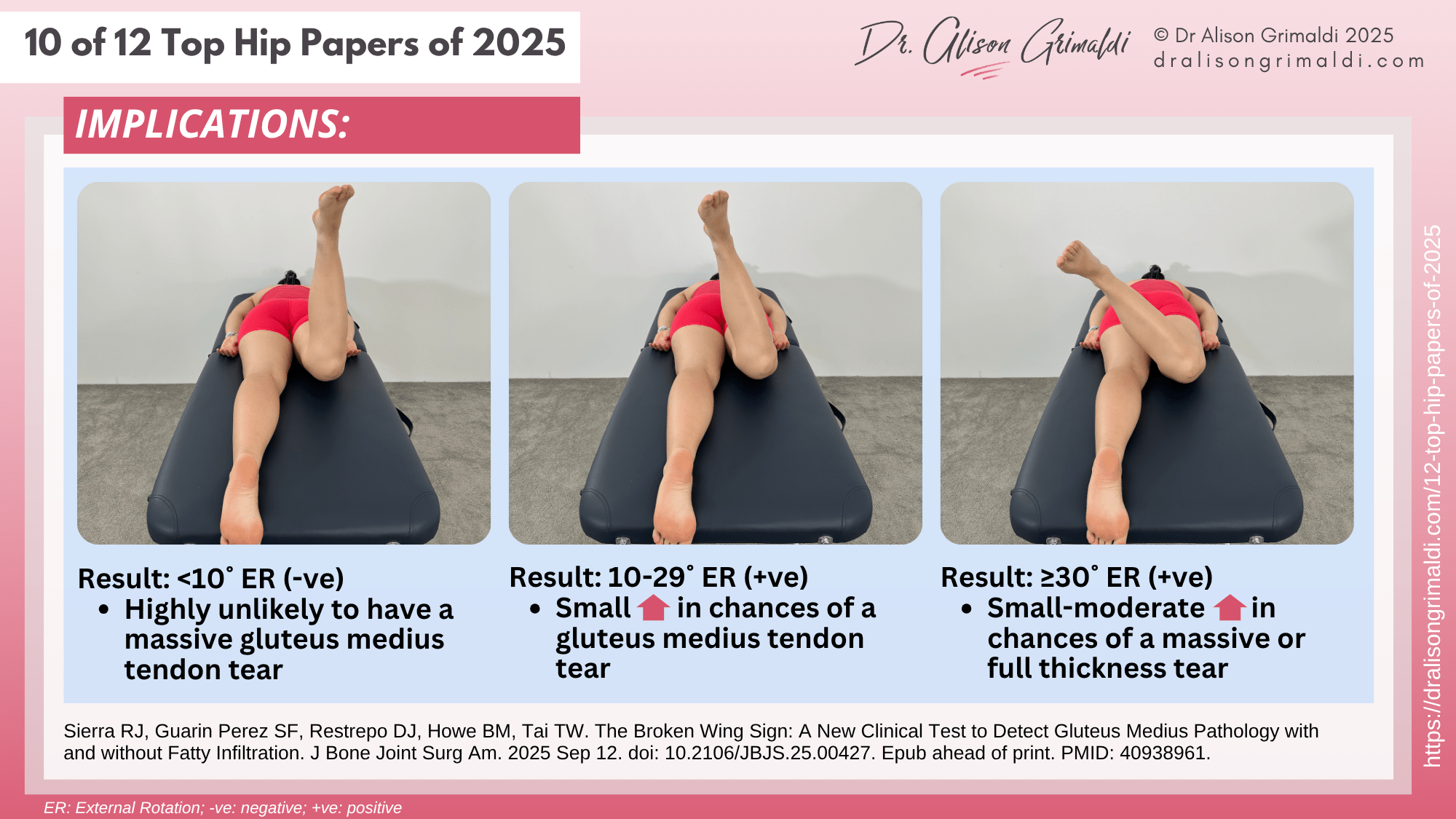
The Broken Wing Sign refers to a loss of axial plane control of the femur during active prone hip extension, with the knee flexed 90degrees. The test is positive when the hip drops into 10˚or more of hip external rotation - watch the angle of the tibia from the vertical. Dropping into 30˚ or more of hip external rotation is considered ‘highly positive’, and more indicative of severe pathology.
Test Population
The test population included 59 patients (75 hips) with suspected hip abductor insufficiency. The mean age was 69.5 ± 10.8 years; and 48 patients (81%) were women.
Magnetic Resonance Imaging (MRI)
MRI was used as the reference standard for detecting gluteus medius tendon tears. Tears were classified as no tear, partial, full-thickness, or massive tears (i.e. ≥3cm retraction from the greater trochanter).
MRI was also used to classify severity of fatty atrophy of the gluteus medius muscle, from 0 (no fatty infiltration) to 4 (extensive fatty infiltration) using the Goutallier classification.
Analysis
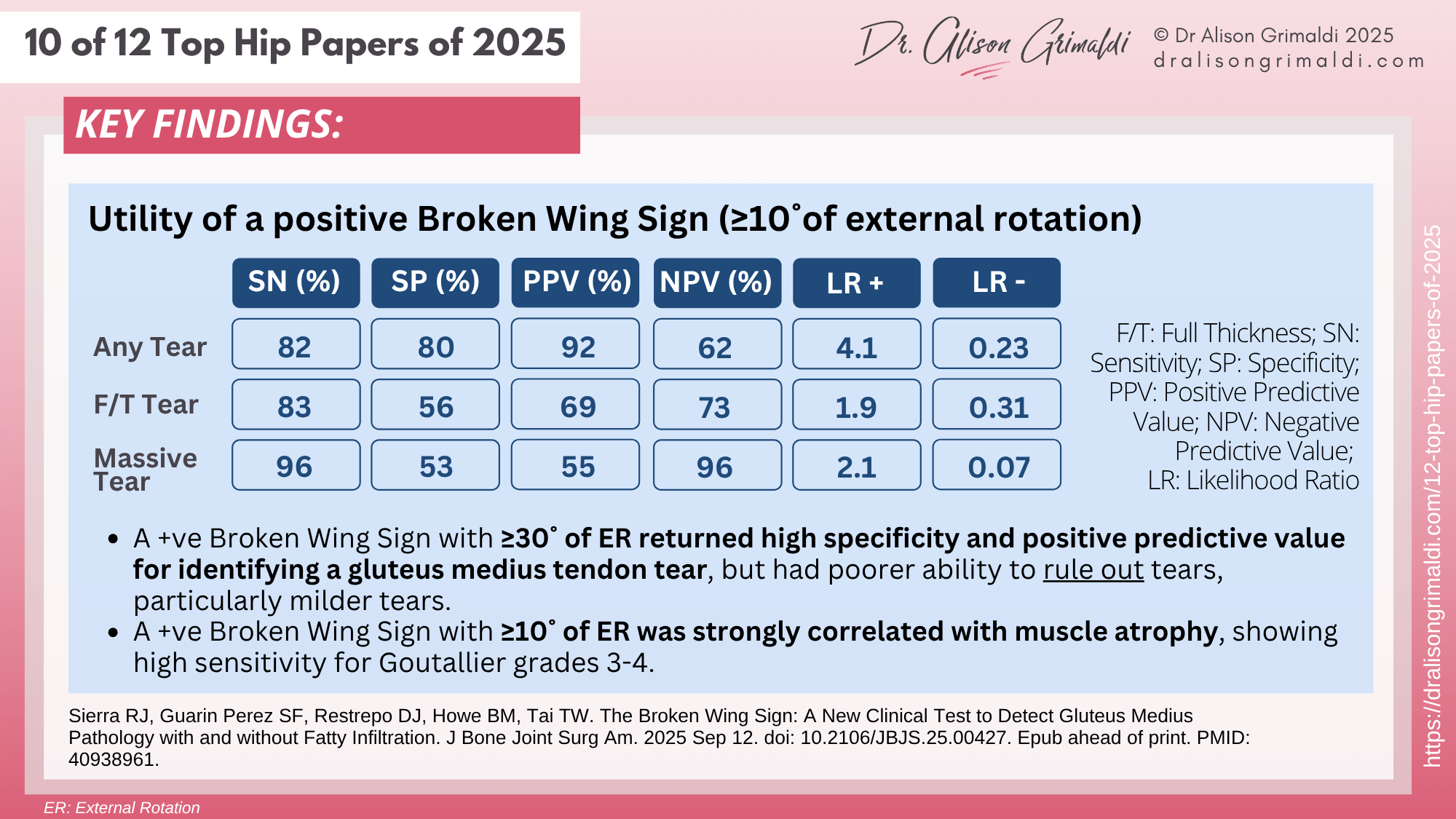
Clinical test results for the Broken Wing Sign were compared against MRI evidence of gluteus medius tendon tears and muscle atrophy with fatty infiltration. Diagnostic utility values were calculated for the detection of any gluteus medius tendon tear, a full thickness tear or a massive tear (partial rupture), and for the prediction of fatty atrophy.
Key Findings:
This study found that:
- A positive Broken Wing Sign with ≥30˚ of ER returned high specificity and positive predictive value for identifying a gluteus medius tendon tear, but had poorer ability to rule out tears, particularly milder tears.
- A positive Broken Wing Sign with ≥10˚ of ER was strongly correlated with muscle atrophy, showing high sensitivity for Goutallier grades 3-4.
Clinical Implications:
Interpreting this new clinical test for detecting gluteus medius tendon tears:
-
If the patient exhibits <10˚ of external rotation during prone hip extension (negative Broken Wing Sign), they are highly unlikely to have a massive gluteus medius tendon tear.
- If the patient exhibits 10-29˚ of external rotation during prone hip extension (positive Broken Wing Sign), there is a small increase in the chances of a gluteus medius tendon tear.
- If the patient exhibits ≥30˚ of external rotation during prone hip extension (positive Broken Wing Sign), there is a small-moderate increase in the chances of a massive or full thickness gluteus medius tendon tear.
- This study was performed on older individuals (≈ 70 yo) & females > males. Further research is needed in other populations.
- Those with weakness of gluteus maximus will often substitute with some hip abduction and external rotation. A rapid and more severe loss of control is more likely to be associated with a substantial gluteus medius tendon tear.
- A patient with a negative Broken Wing Sign is highly unlikely to have a massive gluteus medius tear.
- A positive Broken Wing Sign significantly increases the likelihood of a gluteus medius tendon tear, particularly if the hip drops into more than 30˚ of hip external rotation.
- A positive test was also correlated with muscle fatty atrophy.
You might be wondering why falling into hip external rotation indicates tendon damage and/or atrophy of the gluteus medius muscle, particularly if you are thinking about the gluteus medius muscle as an external rotator. It is important to be aware however, that the more anterior fibres of the gluteus medius act as internal rotators, and it is the anterior gluteus medius tendon fibres that generally develop greater pathology and tearing, as we discussed in another top paper from this year. Muscle atrophy +/- detachment of this part of the tendon will result in a loss of internal rotation function, and the femur drops into external rotation.
We do also often see an active drift into abduction and external rotation during active hip extension from this prone position, in those with gluteus maximus weakness. It is a challenging position in which to test glute max, as it is in a very shortened position. For those with weakness, the nervous system will often harness what it can from the extensor moments of the other posterior hip musculature, the posterior fibres of gluteus medius and minimus, the short external rotators and adductor magnus.
These muscles all have abduction and/or external rotation moments, and thus we see a drift of the femur laterally and the foot inwards. This is usually an active, effort-driven drift though, rather than the rapid loss of control into external rotation that we see with massive gluteus medius tendon tears.
This new clinical test for detecting gluteus medius tendon tears may be quite useful in clinic, but look closely at how the active movement is performed. I would also recommend looking at active function in weightbearing and sidelying, and add in the other new Hip Drop test to provide a variety of challenges to this complex multipennate muscle.

Like to learn more about assessing and managing gluteal tendinopathy?
In this course, you can find detailed information on pathoaetiology, assessment and management of lateral hip pain associated with gluteal tendinopathy (greater trochanteric pain syndrome, trochanteric 'bursitis'), and many other conditions. To learn more, take the Lateral Hip and Buttock Pain Online Course, or join me in a Lateral Hip and Buttock Pain Workshop.
This online course is included in Hip Academy and Hip Academy members receive discounts for online workshops.
I hope you enjoyed the infographics and key learnings from Day 10 of my 12 Top Hip Papers of 2025. There are 2 more papers to come, so keep an eye out, to see what other top papers and infographics I have prepared for you!

Missed paper 9? Click above to read it!

Paper 11 comes out tomorrow!
Sign up to my mailing list for updates and my WEEKLY HIP FACT FILES - with clinically relevant facts, stats, and featured papers.
