
9 of 12 Top Hip Papers of 2025 | Anatomic Study of Hip Pericapsular Muscle Arrangement

Welcome back to my 12 Top Hip Papers of 2025 series of miniblogs, where I review papers that have contributed particularly useful information for hip clinicians in 2025. We are now at Day 9! If you missed day 8, you'll find a link at the bottom of this page to take you back. On day 9, we'll be taking a look at a paper that revealed some intriguing information about how the pericapsular muscles of the hip are arranged around the femoral neck, with implications for the function of the deep hip cuff. Scroll down for more info...
9 of 12 Top Hip Papers of 2025: Anatomic study of hip pericapsular muscle arrangement on the joint capsule1
Background:
The deep hip cuff muscles are intricately connected to the hip joint capsule, with important potential roles to play in fine control of movement and stability of the femoral head within the acetabulum. While our understanding of these important muscles is steadily growing, we still have much to learn.
This anatomic study revealed some intriguing information about how the pericapsular muscles of the hip are arranged around the femoral neck, with implications for the function of the deep hip cuff.
Study Aim:
- To investigate the pericapsular muscle arrangement on the joint capsule, their positions relative to the femoral head and neck and the histological relationships between the pericapsular muscles and the joint capsule.
What was done:
The authors of this study performed a cadaveric dissection study of 8 adult hips. Macroscopic and microscopic analysis of the capsular connections of the deep hip muscles was performed - the iliopsoas (including iliocapsularis in this paper), the gluteus minimus, the obturator internus and gemelli, and the obturator externus muscles.
Methods:
Macroscopic Analysis
- The superficial muscles, including the gluteus maximus and medius, piriformis, tensor fascia latae, sartorius, and hip adductor muscles, were removed to expose the pericapsular muscles.
- The hip pericapsular muscles were defined as:
- the iliopsoas (including iliocapsularis),
- gluteus minimus,
- obturator internus and the gemelli muscles, and
- obturator externus, and their arrangement on the joint capsule was observed.
- The specimens were then cut at the base of the femoral neck to observe the positional relationships around the femoral neck
Histologic Analysis
- Oblique sagittal sections across the femoral head were prepared to allow microscopic assessment of capsular attachment of the pericapsular muscles.
Key Findings:
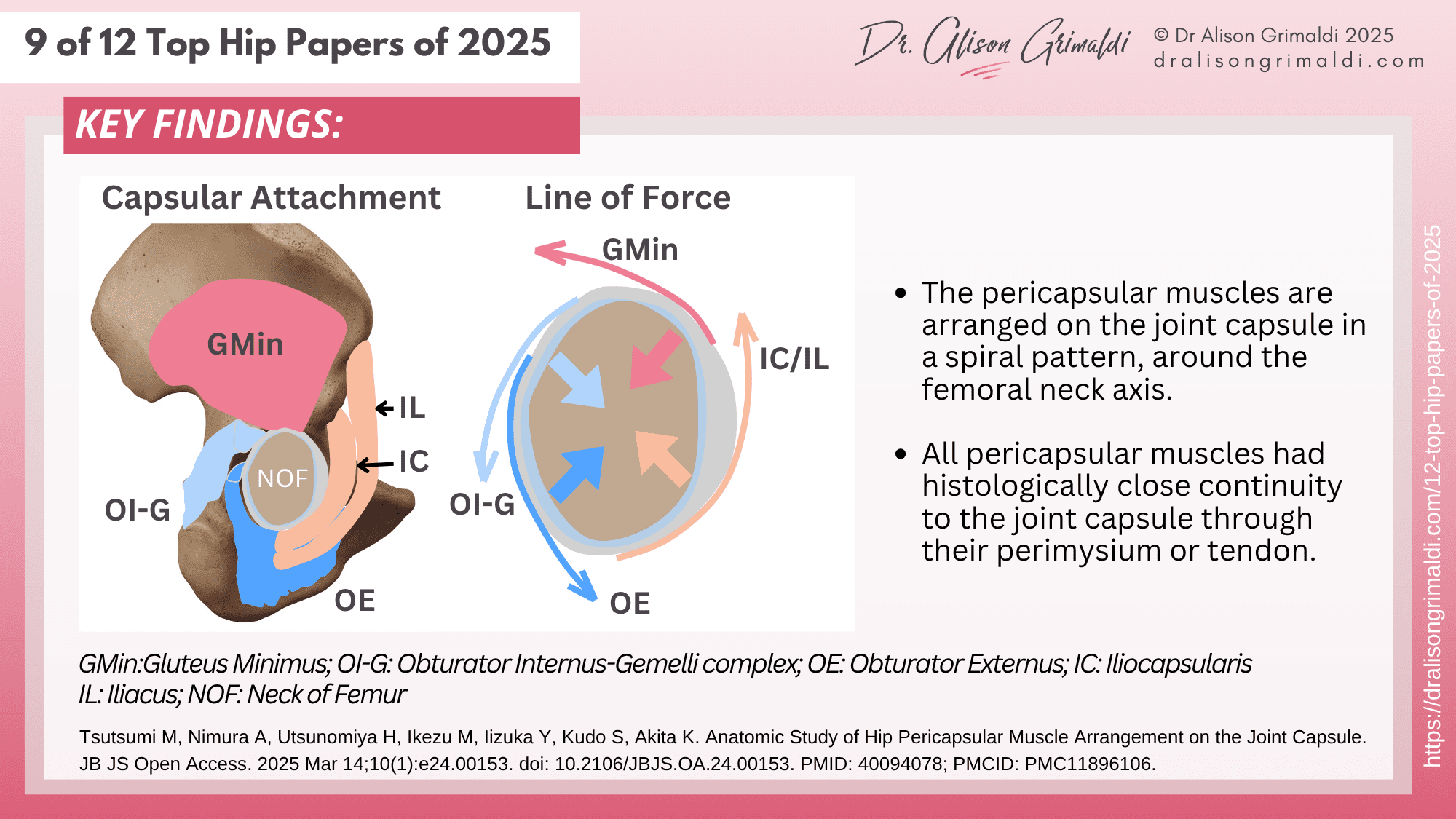
The novel finding here was that the pericapsular muscles attach to the hip capsule in a spiral pattern:
- the iliopsoas/iliocapsularis pulling superiorly from the anterior-inferior joint capsule,
- the gluteus minimus tensioning the capsule from anterosuperior to posterosuperior,
- the obturator internus-gemelli complex pulling downwards from it's attachment on the posterior-posterosuperior surface of the joint capsule, and
- the obturator externus acting in a posteroinferior to anteroinferior direction.
This result is a counterclockwise spiral of tension on the right hip and a clockwise spiral on the left hip, if you were viewing the hip from a lateral perspective. You can also imagine you are standing behind a pelvis, with your hands on the femoral necks, like you were riding a motorbike - the twisting action is like accelerating by pulling up, back and down, around the femoral necks.
Clinical Implications:
- The capsular connections of the pericapsular muscles suggest a curved line of force, accompanied by perpendicular centripetal forces that likely assist in centering the femoral head.
- Injury or dysfunction of one or more of the pericapsular muscles may impair the ability of this system to control translatory forces.
The finding of a spiral arrangement of the deep cuff is very interesting, as the capsule naturally tensions into a close-packed position in hip extension, where there is greatest challenge to anterior hip stability. This orientation of the peri-capsular muscles would serve to protect and support the capsule into hip extension, and to maintain tension in the capsule via active muscle shortening as the hip moves into flexion.
The authors suggest that this orientation of the pericapsular hip muscles will generate centripetal force to centre the head of the femur in the acetabulum. This finding then raises questions as to what happens when there is dysfunction or injury to one part of this spiral phenomenon - e.g., when the gluteus minimus tendon avulses secondary to severe tendinopathy, the iliopsoas/iliocapsularis is detached surgically, or repair of the posterior cuff fails following posterior approach total hip replacement surgery. Not only will there be reduced local support for the joint in the area of normal capsular attachment, but the whole spiral mechanism is likely to suffer, increasing risks of excessive translations - 'microinstability', and degenerative change of the hip joint, or wear of a prosthesis.
What does this mean for the clinician? The peri-capsular muscles of the hip are vital for joint protection but are largely overlooked in generic 'strengthening' programs for the hip. Specificity in our exercise programs may be important, particularly for those at higher risk of hip microinstability.
Like to learn more about muscle and movement control around the hip and pelvis?
In my Dynamic Stabilisation of the Hip and Pelvis Online Course, you can find information on the stability systems of the hip, or attend my practical Mastering Movement of the Hip and Pelvis workshop to hone your clinical skills for assessment and training of the deep hip cuff and femoropelvic motion.
This online course is included in Hip Academy and Hip Academy members receive discounts for online workshops.
I hope you enjoyed the infographics and key learnings from Day 9 of my 12 Top Hip Papers of 2025. There are 3 more papers to come, so keep an eye out, to see what other top papers and infographics I have prepared for you!

Missed paper 8? Click above to read it!

Paper 10 comes out tomorrow!
Want to catch up on the 12 Top Hip Papers from 2021, 2022, 2023, and 2024?
Click below to find out more!
Sign up to my mailing list for updates and my WEEKLY HIP FACT FILES - with clinically relevant facts, stats, and featured papers.
