
8 of 12 Top Hip Papers of 2024 | Evaluating Clinical Tests for Iliopsoas Tendinopathy
Welcome back to my 12 Top Hip Papers of 2025 miniblog series, where I walk you through what has been happening in the hip world over 2025. We are already at Day 8! If you missed day 7, you'll find a link at the bottom of this page to take you back. For day 8, we'll be taking a look at a hip paper from 2025 that reported on the evaluation of Clinical Tests to Diagnose Iliopsoas Tendinopathy, including one new test. Read on to find out more about diagnostic tests for hip flexor pain.
8 of 12 Top Hip Papers of 2025: Evaluation of Clinical Tests to Diagnose Iliopsoas Tendinopathy1
Background:
Clearly differentiating iliopsoas related pain can be difficult. Previous research has demonstrated poor utility of hip flexor stretch, contraction and palpation for predicting acute hip flexor injury, putting a bit of a murky cloud over the clinical entity of 'iliopsoas related groin pain'. This paper reports on a new test for iliopsoas tendinopathy or iliopsoas related groin pain and how it performs relative to other available clinical tests.
This was a retrospective study of iliopsoas related clinical test findings following flouroscopy guided iliopsoas tendon injections, in 44 patients with persistent groin pain - 52% with native hips and 48% post total hip replacement (mean age 48 ± 15 years; 34% male).
Study Aims:
- To determine the diagnostic accuracy of diagnostic tests for iliopsoas related groin pain, including a new test - the Hip External Rotation-Flexion-Ceiling-Test (HEC)
- To detect “good” and “poor” tests for diagnosing iliopsoas tendinopathy based on diagnostic performance before and after anaesthetic injection , and
- To rank all tests, based on this criteria, to identify the best diagnostic tool for iliopsoas tendinopathy.
What was done:
Retrospective results of clinical tests and diagnostic injection were reported for 44 people with persistent groin pain (48% after THA). Clinical tests were ranked based on response to flouroscopically guided local anaesthetic injection to the psoas groove - the groove between the Anterior Inferior Iliac Spine (AIIS) and the iliopectineal eminence.
The psoas groove, as the name suggests, is the pathway via which the iliopsoas passes from within the pelvis, over the pelvic brim, on it's path to the lesser trochanter.
Methods:
- Review of previous test/injection results.
- 11 clinical tests for iliopsoas related groin pain were performed before and after anaesthetic injection in the iliopsoas region, at the superior acetabular roof.
- Reduction in pain post injection was used as the diagnostic reference standard.
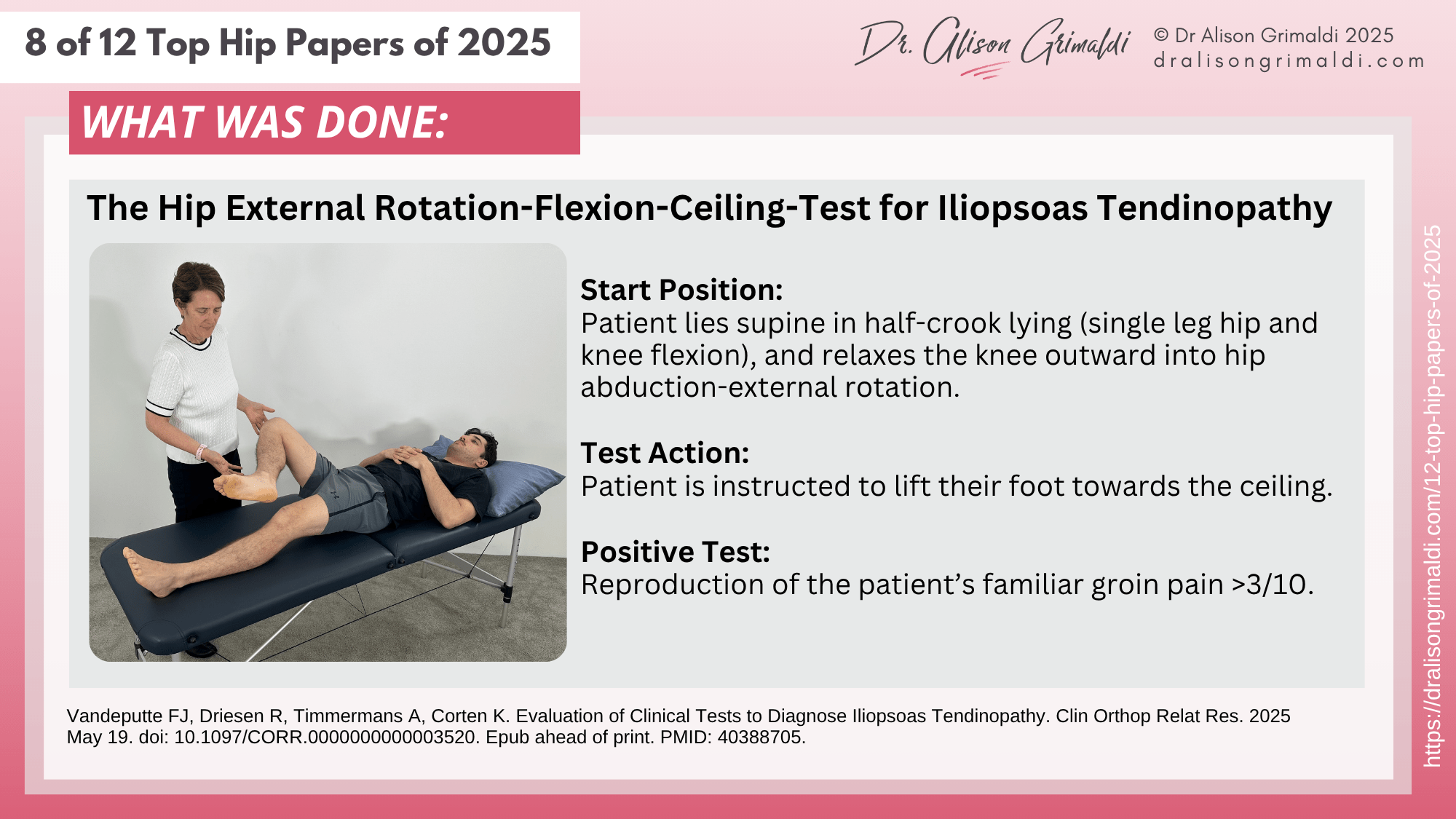
The authors of the paper described and evaluated a new test for iliopsoas tendinopathy - the Hip External Rotation-Flexion-Ceiling (HEC) Test. They suggest that the test may place greater load on the iliopsoas by combining it's flexion role with an external rotation challenge. Ten other common tests for anterior hip pain were included - a combination of soft tissue and hip joint tests.
Other Tests Performed:
- SLR neutral
- SLR in external rotation
- Resisted hip flexion (seated)
- Resisted hip ER (seated)
- Snapping hip test
- FADIR Test
- Scour Test
- Thomas Test
- HEER - (Hip Ext-ER)
- Palpation medial to joint
Analysis:
Test performance was rated on 3 criteria:
- mean pain reduction post injection,
- cutoff value for pain reduction, and
- area under the curve.
Key Findings:
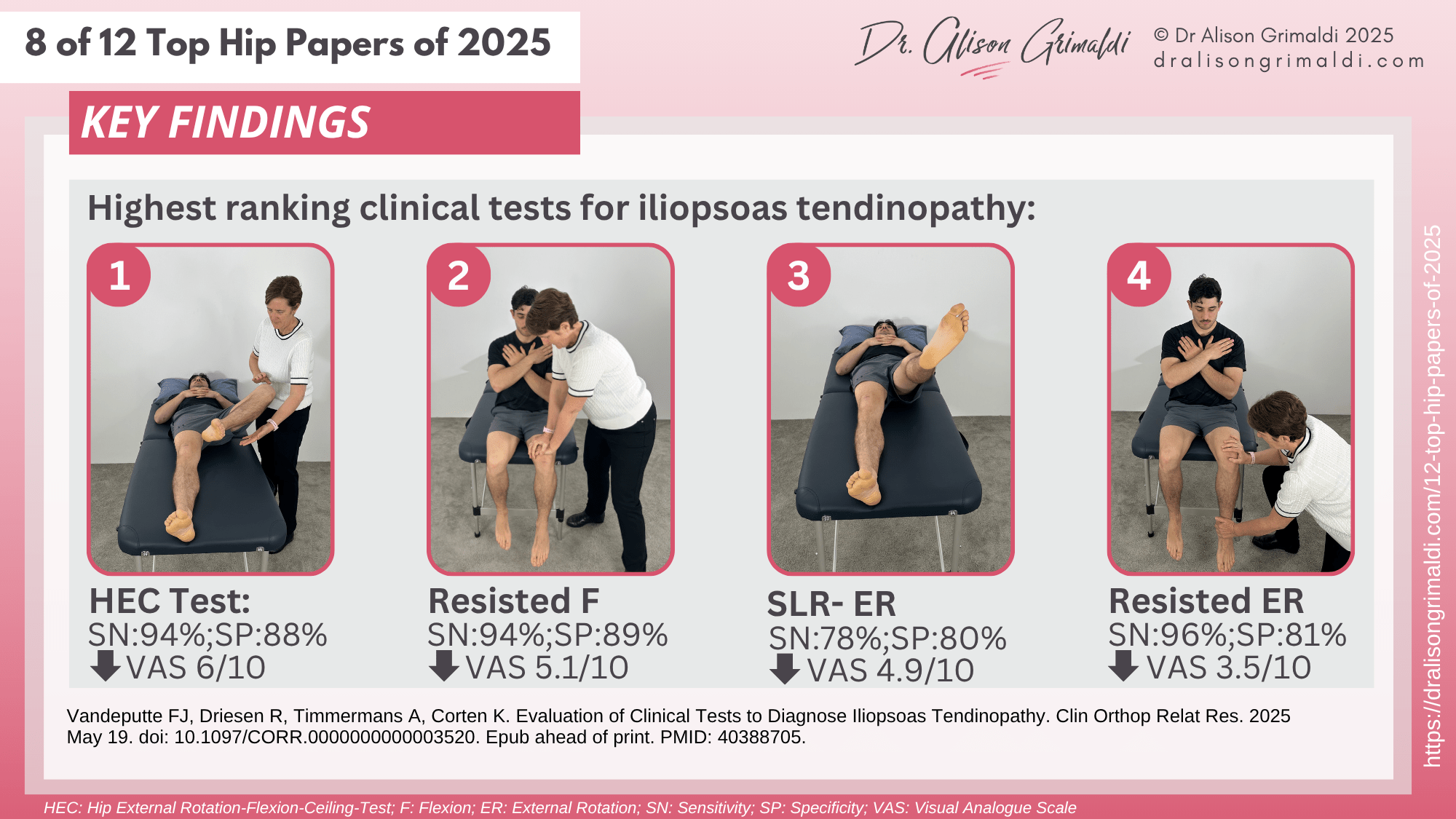
According to these study results, the best tests to detect iliopsoas tendinopathy were:
- The HEC test: Sensitivity 94%; Specificity 88%; Mean pain reduction 6/10
- Resisted hip flexion (seated): Sensitivity 94%; Specificity 89%; Mean pain reduction 5.1/10
- Straight Leg Raise in External Rotation: Sensitivity 78%; Specificity 80%; Mean pain reduction 4.9/10
- Resisted External Rotation (seated): Sensitivity 96%; Specificity 81%; Mean pain reduction 3.5/10.
Clinical Implications:
- Adding the new HEC test to your hip flexor test battery, and also trying SLR in some hip ER, may improve diagnostic accuracy for detecting iliopsoas tendinopathy, or at least hip flexor related pain.
- Flouroscopically guided injections do not allow visualisation of soft tissues, so other tissues may have been impacted by the injection.
- The adjacent pectineus muscle will also be loaded by these clinical tests, particularly the HEC.
- An irritable hip joint may also produce symptoms on these clinical tests. If required, diagnostic injection may help to differentiate.
It's important to note the limitations of this study, including:
- the retrospective nature of the study (introduces significant bias),
- the particant group - relatively small participant numbers and half had a prosthesis in situ (these groups should be tested separately, in larger numbers and prospectively), and
- inherent difficulties in localising injections - the local anaesthestic may well have spread to adjacent tissues, including the pectineus muscle.
We also need to consider that the HEC is also likely to be strongly loading the pectineus. The role of the iliopsoas in the axial plane still remains controversial. From one of the most detailed assessments of iliopsoas function, the psoas major was reported to shift from a small external rotation moment arm in an externally rotated joint position, to a small internal rotation moment arm in a joint position of internal rotation. Iliacus fibres were reported to have a small moment arm for internal rotation throughout the axial plane.
The HEC should load the psoas major and the iliopsoas tendon, but will also load the pectineus, and the sartorius, and the adductors, and the hip joint, and the pubic symphysis ... so we need to be very mindful of asking the patient to point with one finger where they are feeling their pain on this test, and consider the test results within the context of our wider battery of soft tissue and joint screening tests, and patient history.
Further research is needed to improve confidence in diagnostic tests for hip flexor pain, but this study stimulates some much needed interest in this topic.

Like to learn more about assessing and managing hip flexor related pain?
In this course, you can find detailed information on pathoaetiology, assessment and management of hip flexor related pain, and many other soft tissue, joint and nerve conditions causing pain in the anterior hip and groin region. To learn more, take the anterior hip and groin pain online course, or join me in an online or face-to-face anterior hip and groin pain workshop.
Join Hip Lovers and Hip Learners from all around the globe in Hip Academy and benefit from the extensive resources, live member masterclasses, Q & A sessions and Member Case Sharing.
I hope you enjoyed the infographic and key learnings from Day 8 of my 12 Top Hip Papers of 2025. There are 4 more papers to come, so keep an eye out, to see what other top papers and infographics I have prepared for you!

Missed paper 7? Click above to read it!

Paper 9 comes out tomorrow!
Want to catch up on the 12 Top Hip Papers from 2021, 2022, 2023, and 2024?
Click below to find out more!




Sign up to my mailing list for updates and my WEEKLY HIP FACT FILES - with clinically relevant facts, stats, and featured papers.
