
3 of 12 Top Hip Papers of 2025 | Sex Differences in Return to Sport After Hip Arthroscopy

Welcome to day 3 of my 12 Top Hip Papers of 2025 series of miniblogs. If you missed Day 2, you'll find a link at the bottom of this page to take you back. On day 3, we'll be looking at sex differences in return to sport after hip arthroscopy. While the evidence shows that people who have hip arthroscopy are likely to benefit in terms of reductions in pain and improvements in function, return to full function, including return to a similar level of sports performance has been shown to be less common, but is it different for men and women? Are women less likely to return to sports following hip arthroscopy compared to men? Read on to find out.
And don't forget to claim your special discount on Hip Academy joining fee - we are already 3 days in to this 12 day limited offer.
SPECIAL Xmas Offer!
Read until the end to claim a very special Christmas offer I have prepared just for you!
LIMITED TIME ONLY! ENDS MIDNIGHT 24th DECEMBER
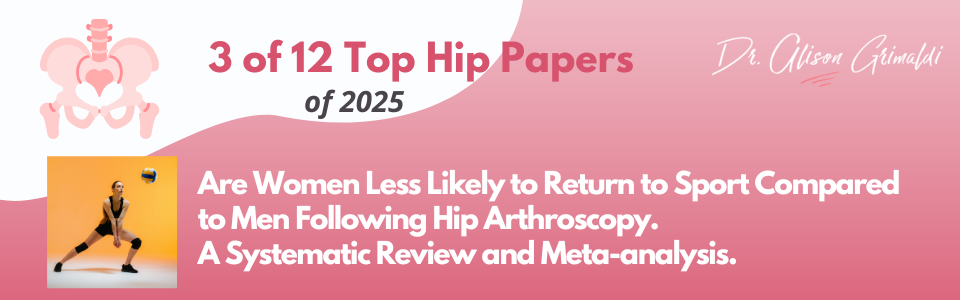
3 of 12 Top Hip Papers of 2025: Are women less likely to return to sport following hip arthroscopy compared to men?1
Background:
This new hip paper aimed to find out if women are less likely to return to sport following hip arthroscopy compared to men. Over 85% of individuals who undertake hip arthroscopy are reported to return to sport (although this may not be at a similar level or level of performance), but is it different for men and women?
This study is a systematic review and meta-analysis of data from studies reporting outcomes of primary hip arthroscopy.
Study Aims:
- To compare females’/women's and males’/men’s Return-To-Sport (RTS) following hip arthroscopy and
- Explore the reporting and consideration of social and structural determinants of health in RTS outcomes.
What was done:
Methods:
- A prospectively registered systematic review and meta-analysis was conducted in accordance with the PRISMA guidelines.
- Studies were included if they assessed return-to-sport after hip arthroscopy and analysed the influence of sex/gender on RTS outcomes.
- Data was pooled and meta-regressions conducted to compare RTS outcomes between females/women/girls and males/men/boys.
Results of the Systematic Review:
- 45 studies were included, providing data on 2,046 females and 3,454 males with an average age range of 16 to 41.5 years at the time of surgery.
- Surgery had been performed to address intra-articular pathology, including FAIS and dysplasia or borderline dysplasia.
A meta-analysis of the data was then performed to compare rates of Return to Sport between males and females, and extract information on any factors that may contribute to any differences.
Key Findings:
The answer is ‘YES’! Women are less likely to return to sport compared to men following hip arthroscopy - females had 47% lower odds of participating in sport than males at the same/higher level at 1-3 years post-operatively, and 54% lower odds of participating in sports at any level after 3 years post surgery.
But it seems no-one has tried to explore why. As Return To Sport is often a key goal of surgery, we need to know why women are less likely to get back to sport. The authors suggest that the reasons may be multi-factorial, including biological (e.g., generalised joint laxity), psychological (possibly higher rates of kinesiophobia and fear of re-injury) and social factors (e.g., family demands or shifting social priorities in this age group).

Clinical Implications:
- Are women less likely to return to sport compared to men following hip arthroscopy? YES
- Do we know why? NO, although the evidence to date suggests that RTS is not solely associated with level of pain and symptoms.
- Biological factors such as joint laxity, psychological factors such as kinesiophobia and fear-of-reinjury, and social factors that may influence opportunity for RTS may all play a role.
- Further research is required to clarify these factors. In the meantime, clinicians should aim to understand an individual’s barriers and support them in their RTS goals.
The factors underlying lower return to sport rates in females need to be clarified through research studies, but we can begin our own assessment of these factors on an individual level in our clinics. Is there something different we need to do for women to help them achieve RTS goals? Ask more questions, consider potential factors and aim to assist women overcome barriers to return to sport, if that was a key pre-operative goal for them.

SPECIAL HOLIDAY OFFER!
$100 OFF
your Hip Academy joining fee
Offer Only Available During the 12 Hip Days of Christmas (13th-24th December). Do not miss this exclusive offer!
Now only AUD $345 (usually $445) to join to receive immediate access to over $4,800 worth of content!!
(AUD$345 equates to approximately 181 GBP and 230 USD)
USE COUPON CODE: xmas25hip
Like to learn more about assessing and managing patients with groin pain, FAIS and dysplasia?
In this course, you can find detailed information on pathoaetiology, assessment and management of groin and anterior hip pain conditions. To learn more, take the anterior hip and groin pain online course, or join me in a face to face or practical anterior hip and groin pain workshop.
This online course is included in Hip Academy and Hip Academy members receive discounts for online workshops.
I hope you enjoyed the infographics and key learnings from Day 3 of my 12 Top Hip Papers of 2025. There are 9 more papers to come! So keep an eye on the graphics below, to see what other top papers and infographics I have prepared for you!

Missed paper 2? Click above to read it!

Paper 4 comes out tomorrow!
Want to catch up on the 12 Top Hip Papers from 2021, 2022, 2023, and 2024?
Click below to find out more!
Sign up to my mailing list for updates and my WEEKLY HIP FACT FILES - with clinically relevant facts, stats, and featured papers.
