
Femoral retroversion is less than typical twist in the femur
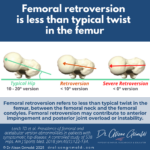
Femoral retroversion refers to less than typical twist in the femur, between the femoral neck and the femoral condyles. Femoral retroversion may contribute to anterior impingement and posterior joint overload…
Read MoreExcessive femoral anteversion is more than typical twist in the femur
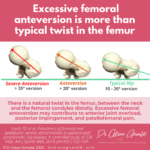
There is a natural twist in the femur, between the neck and the femoral condyles distally. Excessive femoral anteversion may contribute to anterior joint overload, posterior impingement, and patellofemoral pain.
Read MoreFemoral head translations are influenced by bony anatomy
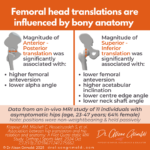
Data from an in-vivo MRI study of 11 individuals with asymptomatic hips (age, 23-47 years; 64% female) Note: positions were non-weightbearing & held passively
Read MoreFemoral head translations occur naturally during motion, most consistently in flexion & abduction
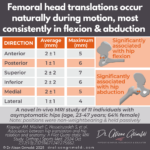
A novel in-vivo MRI study of 11 individuals with asymptomatic hips (age, 23-47 years; 64% female) Note: positions were non-weightbearing & held passively
Read MoreLarger intertuberous distance is associated with Ischiofemoral Impingement
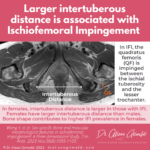
In females, intertuberous distance is larger in those with IFI. Females have larger intertuberous distance than males. Bone shape contributes to higher IFI prevalence in females.
Read MoreLarger femoral neck – shaft angle (NSA) reduces the ischiofemoral space
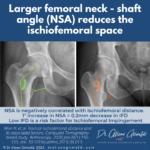
NSA is negatively correlated with ischiofemoral distance. 1° increase in NSA = 0.2mm decrease in IFD Low IFD is a risk factor for Ischiofemoral Impingement
Read More