
7 of 12 Top Hip Papers of 2025 | Understanding Acetabular–Femoral Orientation in Hip Dysplasia

Today is Day 7 of my 12 Top 2025 hip papers - papers that have contributed to our understanding of hip conditions and/or the assessment or management of hip pain or injury. If you missed Day 6, you'll find a link at the bottom of this page to take you back. We've covered a heap of great papers with meaningful clinical implications already. The top hip paper for Day 7 investigated the relationships between acetabular and femoral orientation in dysplasia. The information presented helps us better understand bone shape in hip dysplasia (and other conditions) and provides a novel way to estimate 3-dimensional bone shape from 2-dimensional x-rays. This can be very handy when you only have access to radiographs, and you might suspect some malversion. Read on to find out more.
7 of 12 Top Hip Papers of 2025: Understanding relationships between acetabular & femoral orientation in dysplasia1
Background:
The shape of the proximal femur and acetabulum can have substantial impacts on hip joint stability, range of motion and health. Bone shape changes during childhood and adolescence, particularly orientation of the proximal femur and acetabulum in the coronal and axial planes. Understanding bone shape in hip dysplasia and other hip joint related conditions usually requires 3 dimensional imaging, most commonly via computerised tomography (CT), or Magnetic Resonance Imaging (MRI), which may not always be readily accessible.
By better understanding the relationship between coronal and axial plane structure, important indicators of axial plane shape (version) might be gained from 2-dimensional coronal plane radiographs. This study is a retrospective imaging study of 202 patients (404 hips) with developmental dysplasia of the hip (DDH) - 99 female patients, mean age of 58.4 ± 16.6 years.
Study Aims:
i) To investigate the correlations between:
- acetabular anteversion (AAV) and acetabular abduction (AAB), &
- combined anteversion and combined abduction in patients with DDH, attempting to give evidence for synchronous torsion of the proximal femur and acetabulum.
ii) To propose a new method for predicting acetabular anteversion and combined anteversion angles, respectively, based on acetabular abduction and combined abduction angles on conventional pelvic radiographs.
What was done:
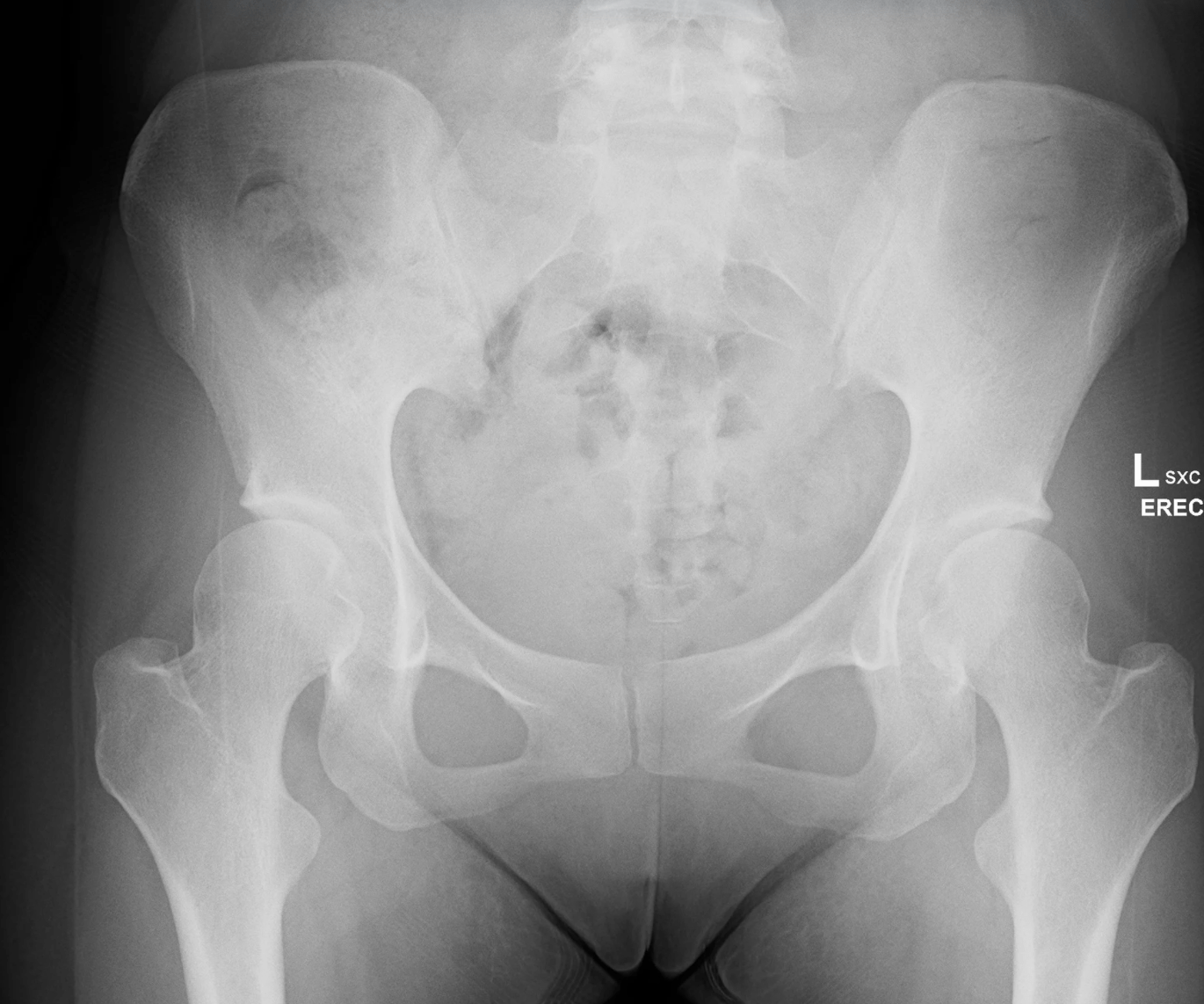
Method:
- Acetabular abduction and femoral neck-shaft angle (FNA) were recorded via x-ray.
- Acetabular and femoral anteversion were recorded via CT scan.
- Correlations were assessed with linear regressions and Pearson's coefficients.
Acetabular abduction refers to uptilt of the socket in the coronal (frontal) plane. Femoral abduction refers to the femoral neck-shaft angle. Anteversion is the twist in the acetabulum and the femur in the axial plane.
Combined abduction is the addition of acetabular abduction (coronal plane tilt) + femoral abduction (neck-shaft angle). Combined anteversion is the additional of femoral and acetabular anteversion. Correlations between combined abduction and anteversion were investigated.
Key Findings:
This study progressed our understanding of bone shape in hip dysplasia (and other hip joint related conditions). Acetabular anteversion and acetabular abduction demonstrated a moderate positive correlation - i.e. the more the acetabulum tilts up, the more it faces forward.
Positive correlations were also observed between combined anteversion and combined abduction.
A new prediction formula was developed: Combined anteversion = 0.6530 × combined abduction − 76.08.
Clinical Implications:
- Simultaneous and synchronized twisting of the acetabulum and femur occur under mechanical forces during childhood:
- the acetabulum twists backwards and downwards AND
- the femoral neck twists backwards and downwards.
- Excessive residual abduction and anteversion of the acetabulum and femur at the end of growth, will reduce stability of the hip joint and predispose to the development of pain and osteoarthritis.
- CT Scans are not always available for measuring version, but this study provides a new prediction formula that can estimate the combined anteversion angle (twist of the femur and acetabulum in the axial plane) from an AP x-ray
- Look at your patient’s x-rays - there is much to be learnt!
The acetabulae and femurs synchronously twist back and down due to mechanical forces during childhood. Weightbearing activity is so very important for this development of bony shape - femoral and acetabular - in our children.
Some hips may not twist back adequately - i.e. excessive residual femoral and/or acetabular anteversion, predisposing to reduced anterior hip joint stability. CT scans are the most common imaging modality used to determine femoral and acetabular anteversion, however CT scans are not always available, are more expensive and carry higher doses of radiation. This study has shown that coronal orientation of the acetabulum and femoral neck can predict combined anteversion (twist in the axial plane).
Simple AP x-rays can provide important information about morphology. So make sure you start looking at these yourself, as these morphological indices are rarely reported in standard radiology reports.

Like to learn more about assessment and management of hip joint related pain?
In this course, you can find detailed information on pathoaetiology, assessment and management of hip joint related pain, as well as soft tissue and nerve related conditions. To learn more, take the anterior hip and groin pain online course, or join me in an online or practical anterior hip and groin pain workshop.
This online course is included in Hip Academy and Hip Academy members receive discounts for online workshops.
I hope you enjoyed the key learnings from Day 7 of my 12 Top Hip Papers of 2025. There are 5 more papers to come, so don't miss out! Keep following the 12 Hip Days of Christmas for 2025 to see what other top papers and infographics I have prepared for you!

Missed paper 6? Click above to read it!

Paper 8 comes out tomorrow!
Want to catch up on the 12 Top Hip Papers from 2021, 2022, 2023, and 2024?
Click below to find out more!
Sign up to my mailing list for updates and my WEEKLY HIP FACT FILES - with clinically relevant facts, stats, and featured papers.
