
4 of 12 Top Hip Papers of 2025 | Influence of hip morphology on gluteal muscle biomechanics
Welcome back for day 4 of my 12 Top Hip Papers series of miniblogs from 2025. If you missed Day 3, you'll find a link at the bottom of this page to take you back. The featured paper for day 4 explored teh relationships between hip morphology and gluteal muscle biomechanics. Does femoral and pelvic bony morphology impact on the ability to generate hip abductor muscle force and loads imposed at the greater trochanter? Read on to find out. This information has relevance to management of gluteal tendinopathy/GTPS and more broadly, on understanding abductor muscle function.
If you are keen to join other hip lovers and hip learners from around the world in Hip Academy, don't forget to grab the opportunity to join at our special 12 days of Christmas rate.

EARLY BIRD OFFER! SAVE $$$
Lateral Hip & Buttock Pain
Online Workshop!!!
OFFER ENDS IN:
ONLY AUD $415 (approx. USD 290 or GBP 219)
4 of 12 Top Hip Papers of 2025: Influence of hip morphology on gluteal muscle biomechanics1
Background:
This new hip paper reported on the influence of hip morphology on hip abduction force generation and both tensile and compressive tendon loads experienced at the lateral hip, with relevance to hip abductor function and lateral hip pain (Gluteal Tendinopathy, GTPS).
This study is a computational modeling study of the influence of hip morphology on gluteal muscle biomechanics.
Study Aim:
- To study how femoral neck shaft angle (NSA) and iliac wing width (IWW) influence gluteal muscle forces, moment arms, and estimated tendon loads during walking.
- To provide insights into biomechanical factors that may potentially contribute to altered lateral hip loading patterns.
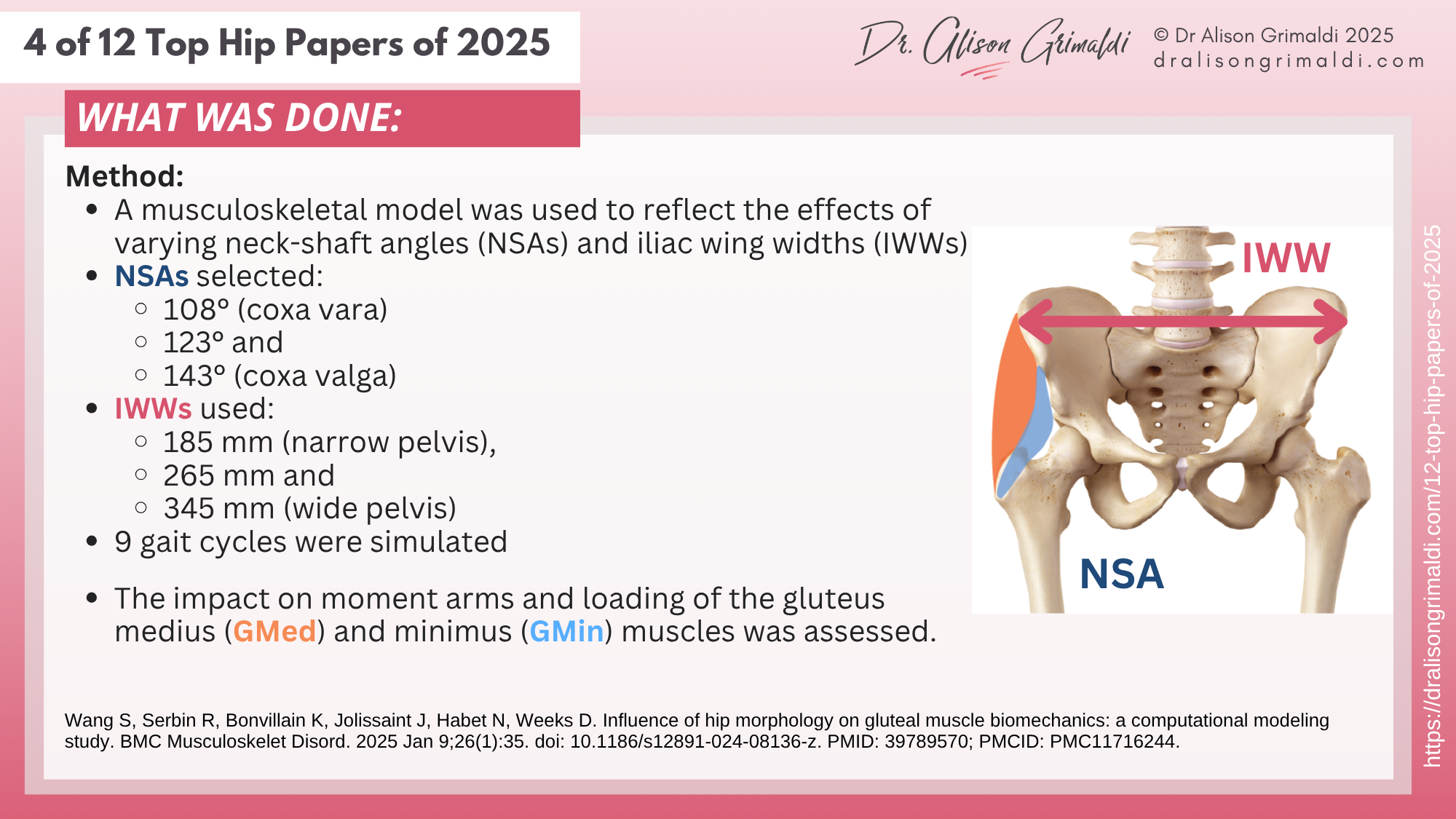
What was done:
Methods:
A musculoskeletal model was used to assess the effect of varying femoral neck-shaft angle and pelvic width (iliac wing width) on gluteus medius and minimus moment arms and the subsequent influence on muscle forces generated and estimated tendon loads during gait.
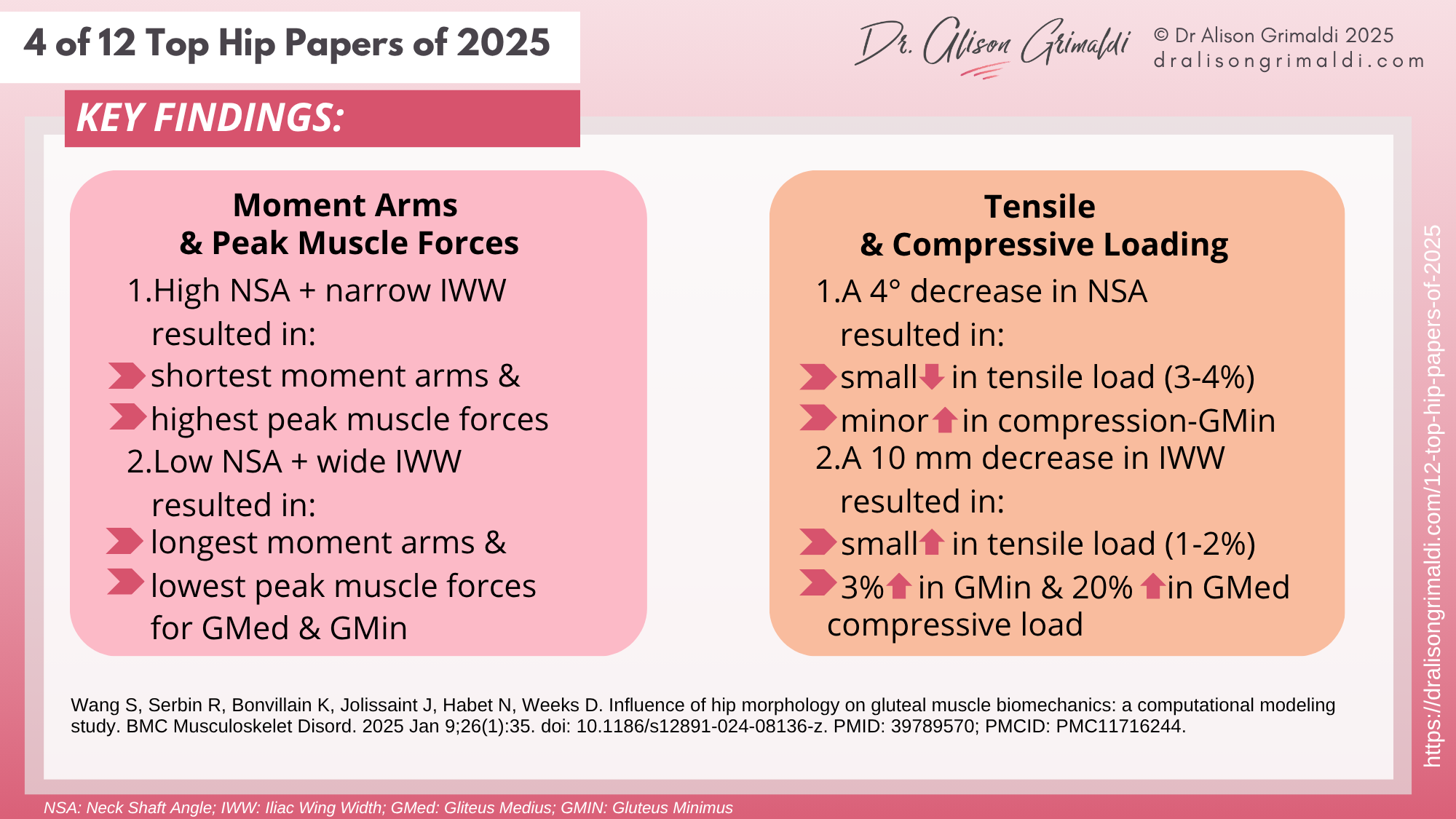
Key Findings:
Neck shaft angle and pelvic width both significantly impact on gluteus medius and minimus moment arms, peak forces and estimated tendon loads.
High neck shaft angle (a more vertical femoral neck) or narrow pelvic width resulted in the shortest moment arms and highest peak muscle forces, while a low neck shaft angle (more horizontally oriented femoral neck) or a wider pelvis resulted in the longest moment arms and lowest peak abductor muscle forces - ie they didn't need to work as hard due to the better lever arm.
A 4 degree reduction in neck shaft angle resulted in a small decrease in tensile abductor tendon load and a minor increase in gluteus minimus tendon compression. A 10mm decrease in iliac wing width (pelvic width) resulted in a small increase in tensile load and a 3% increase in gluteus minimus and 20% increase in gluteus medius compressive load.
Clinical Implications:
- High NSAs (more vertical femoral necks) result in lower trochanteric offset. The gluteus medius and gluteus minimus of those with 'narrower hips’ (width across the greater trochanters) are mechanically disadvantaged.
- Those with 'wider hips’ (low NSA) and pelvises don’t need to generate as much force from their gluteus medius and minimus due to better lever arms.
- Morphology may contribute to high tensile and compressive loads in gluteal tendinopathy, but other factors are at play, including iliotibial band compression and kinematics - this is potentially modifiable!
Those with high neck shaft angle will have more vertical femoral necks and their greater trochanters will be closer to the pelvis (lower trochanteric offset). This results in a poorer lever arm and means that people with narrower 'hips' (width across the greater trochanters), have to work harder to achieve the same pelvic control in single leg function. Abductor weakness in this population then is apparent more quickly - something to be mindful of in abductor rehabilitation, including after total hip arthroplasty, where sometimes the patient may end up with a reduced offset. This can have a marked impact on abductor function due to the loss of moment arm. You'll often then see trunk side flexion in single leg function, to compensate for the loss of abductor lever arm.
The relatively higher forces that need to be generated in those with 'narrower hips' (higher neck shaft angles - coxa valga) may contribute to tensile overload of the gluteus medius and minimus tendons in some people. Those with lower neck shaft angles will have more prominent greater trochanters laterally (greater offset). This provides a mechanical advantage for gluteus medius and minimus, so they don't have to work as harder relatively. A wider pelvis also contributes to this advantage.
What about the effect on tendon compression? There will be some inherent increases in compression associated with the muscles having to work harder - as they tug and tighten around the greater trochanter. There should also be higher compressive load if the tendon is pulling more obliquely in those with greater trochanteric offset (lower neck shaft angle). The model didn't account for the local relationship between the tendon and underlying greater trochanter, and also didn't factor in the impact of the overlying iliotibial band. Previous work has shown that lower neck shaft angle results in greater compressive load as the iliotibial band wraps around the prominent trochanters in those with lower neck shaft angles.
Morphology alone does not explain variations in tendon load. Hip position (degree of hip adduction) and kinematics - (relative positioning of the femur, pelvis and trunk) may have a marked impact on tendon loads, and this is something that is potentially modifiable and a target in our rehabilitation. Understanding how morphology influences muscle function and forces may however help in understanding why some patients seem to have to work harder to restore their abductor function and may be slower in their recovery.

SPECIAL HOLIDAY OFFER!
$100 OFF
your Hip Academy joining fee
Offer Only Available During the 12 Hip Days of Christmas (13th-24th December). Do not miss this exclusive offer!
Now only AUD $345 (usually $445) to join to receive immediate access to over $4,800 worth of content!!
(AUD$345 equates to approximately 181 GBP and 230 USD)
USE COUPON CODE: xmas25hip
Like to learn more about managing gluteal tendinopathy?
In this course, you can find detailed information on pathoaetiology, assessment and management of lateral hip pain associated with gluteal tendinopathy (greater trochanteric pain syndrome, trochanteric 'bursitis'), and many other conditions. To learn more, take the online course, or join me in a workshop.
Join our community of Hip Lovers & Hip Learners at Hip Academy, and experience the confidence that comes with access to high-quality continuing professional development, resources and support.
I hope you enjoyed the infographics and key learnings from Day 4 of my 12 Top Hip Papers of 2025. There are 8 more papers to come in this series, so keep an eye out below as they come out, to see what other top papers and infographics I have prepared for you!

Missed paper 3? Click above to read it!

Missed paper 5? Click above to read it!
Want to catch up on the 12 Top Hip Papers from 2021, 2022, 2023, and 2024?
Click below to find out more!
Sign up to my mailing list for updates and my WEEKLY HIP FACT FILES - with clinically relevant facts, stats, and featured papers.
