
5 of 12 Top Hip Papers of 2025 | Ischiofemoral Impingement in Younger Adults With Hip Pain
It's day 5 of my 12 Top Hip Papers of 2025 miniblog series! If you missed any of the previous days, you'll find a link at the bottom of this page to work backwards, or you can visit the main page here - 12 top papers of 2025. For day 5 we'll be taking a look at the prevalence of Ischiofemoral Impingement (IFI) in younger adults with hip pain. IFI, presenting as lower buttock/retro-trochanteric pain is much more prevalent than most clinicians realise, resulting in a lack of early diagnosis and inadequate outcomes. So the first step is in increasing awareness of the prevalence of this condition. Read on to find out more.
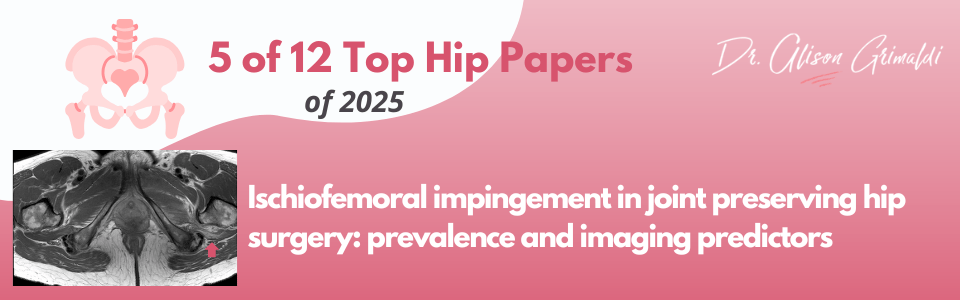
5 of 12 Top Hip Papers of 2025: Prevalence of Ischiofemoral Impingement (IFI) in younger adults with hip pain1
Background:
This new hip paper reported on the prevalence of Ischiofemoral Impingement in young adults with hip pain, who had undergone imaging to assist in determining their eligibility for joint preserving surgery - for example, for femoroacetabular impingement syndrome (FAIS) or acetabular dysplasia.
Ischiofemoral Impingement refers to impingement of soft tissues between the ischium and lesser trochanter. The primary tissue impinged is the quadratus femoris muscle, but the lateral aspect of the hamstring tendons and the iliopsoas tendon of insertion can also sometimes be affected. In some cases, symptoms from the overlying sciatic nerve may also develop.
This study is a retrospective imaging study of 256 hips of younger adults presenting with hip pain (224 patients, mean age 34 years), examined with radiographs and Magnetic Resonance Arthrography.
Study Aims:
- To determine the prevalence of ischiofemoral impingement (IFI) in young patients evaluated for joint preserving hip surgery, and
- To investigate its associations with osseous deformities and intra-articular pathologies.
What was done:
This retrospective imaging study of over 200 younger adults with hip pain looked for quadratus femoris oedema on Magnetic Resonance Imaging (MRI), to determine the prevalence of Ischiofemoral Impingement in this cohort. They also looked for possible relationships with pathology, and morphology of the acetabulum and femur, to assess possible risk factors.
Method:
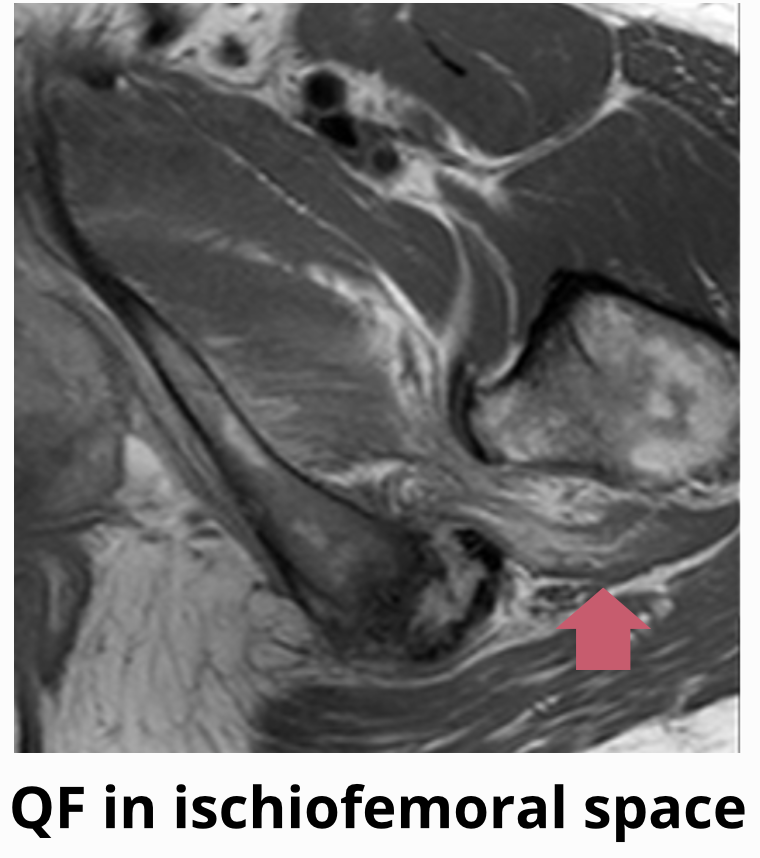
- Quadratus femoris muscle oedema on Magnetic Resonance Imaging (MRI) was used to indicate IFI and measurements of the ischiofemoral space were performed.
- Imaging analysis assessed cam deformity, femoral torsion, neck-shaft angle, ischial angle, acetabular coverage, version, and chondro-labral pathology.
- Prevalence of IFI was calculated and associations between IFI and hip morphology and pathology were identified with logistic regressions.
Key Findings:
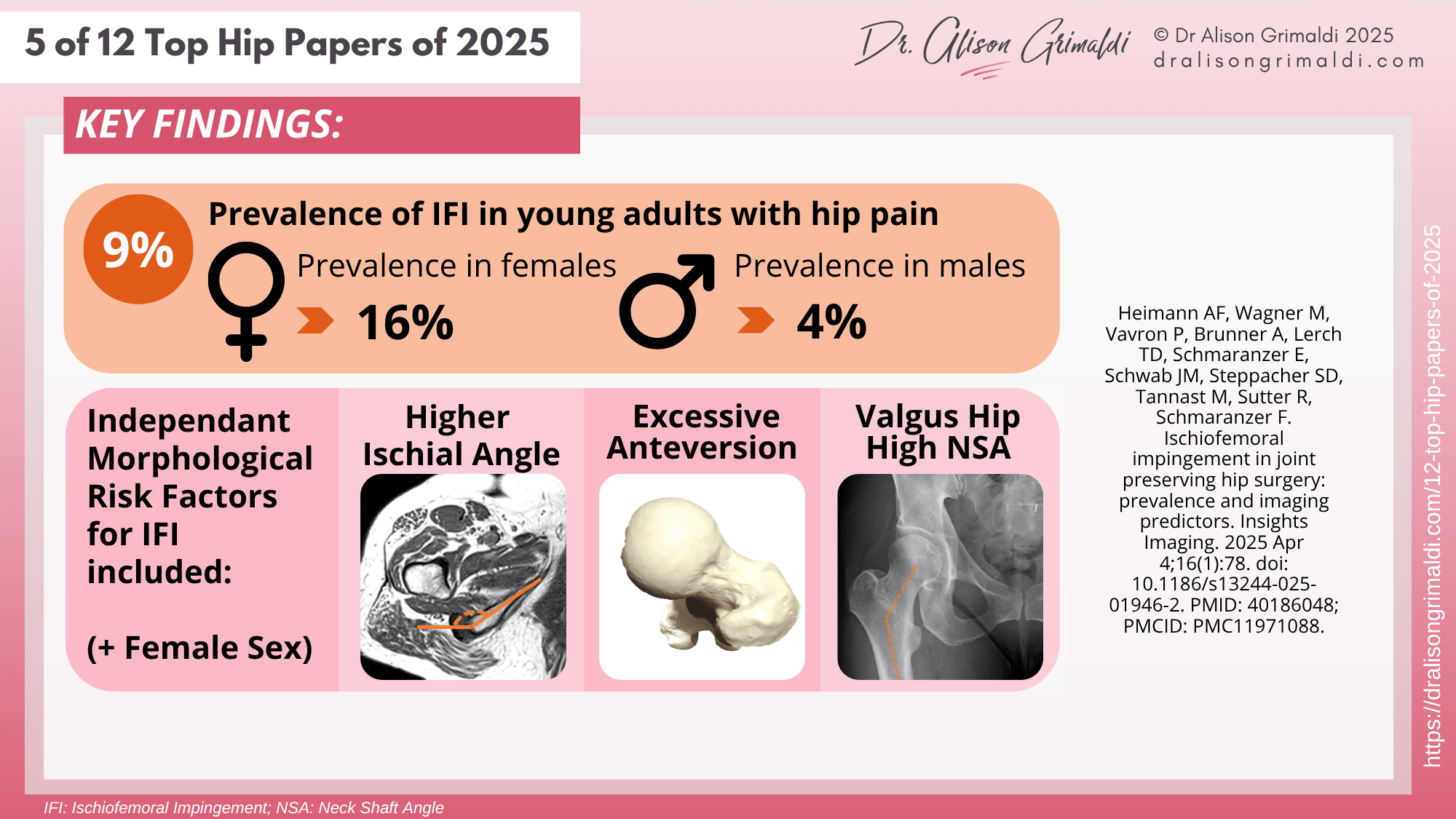
IFI (quadratus femoris oedema) was detected in 9% of hips, with a higher prevalence in women - occurring in 16% of younger women with hip pain. Independant morphological risk factors that were detected included a higher ischial angle, excessive anteversion and a valgus hip (higher neck shaft angle - a more vertically oriented femoral neck).
Clinical Implications:
- IFI is underrecognised, but has reasonably high prevalence, particularly in females presenting with hip pain.
- Females tend to be more at risk due to natural bony structure.
- Look out for IFI as a primary or additional pain source in those presenting with hip pain. Lack of attention to IFI may result in ‘failed conservative care’ and unnecessary referral for surgical intervention.
- While morphology is a key factor, movement and muscle factors are modifiable through rehabilitation.
It has previously been established that IFI is more common in females due to our natural pelvic shape - the ischia sit wider to allow for childbirth, reducing the space between the femur and the ischium.
Excessive femoral anteversion can increase the chances of posterior impingement, due to the fact that for any knee position, someone with excessive femoral anteversion will be in relatively greater hip external rotation - resulting in closing down of the ischiofemoral space. Females are more likely to finish growth with excessive femoral anteversion as growth plates in females close earlier resulting in less time to derotate (we are all born with excessive anteversion and gradually derotate during childhood and adolescence). This morphological trait then also contributes to the higher prevalence of IFI in females.
A high femoral neck shaft angle can bring the femur closer to the ischium. This can be due to natural morphology, but also sometimes occurs after total hip replacement, so look at your patient's x-rays and the space between the lesser trochanter and ischium.
IFI most commonly presents as retro-trochanteric pain - pain in the lower buttock, behind the greater trochanter. IFI is often noted in papers to be ‘rare’ but this study suggests the prevalence is likely to be higher than recognised, particularly in females. In my experience, this condition is often misdiagnosed as gluteal tendinopathy, or assumed to be referred from the lumbar spine, SIJ or hip joint.
Make sure you don’t miss IFI as a primary or additional pain source.

Like to learn more about diagnosing and managing Ischiofemoral Impingement?
In this course, you can find detailed information on pathoaetiology, assessment and management of ischiofemoral impingement, and many other lateral hip and buttock pain conditions. To learn more, take the online course, or join me in a workshop.
This online course is included in Hip Academy and Hip Academy members receive discounts for online workshops. In Hip Academy, you will also find an additional meeting masterclass recording on post-operative management after hip arthroscopy.
I hope you enjoyed the infographics and key learnings from Day 5 of my 12 Top Hip Papers of 2025. There are 7 more papers to come, so keep and eye out, to see what other top papers and infographics I have for you!
Missed paper 4? Click above to read it!

Paper 6 comes out tomorrow!
Want to catch up on the 12 Top Hip Papers from 2021, 2022, 2023, and 2024?
Click below to find out more!
Sign up to my mailing list for updates and my WEEKLY HIP FACT FILES - with clinically relevant facts, stats, and featured papers.
